
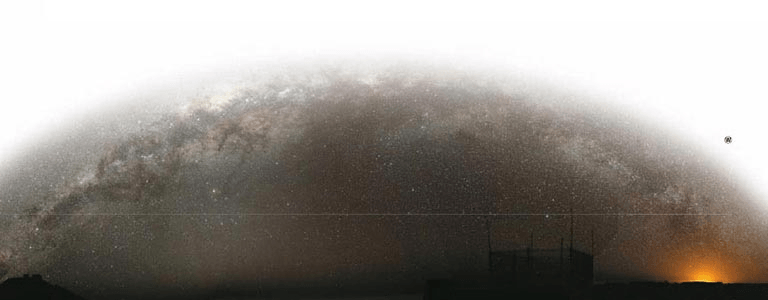
How many stars can an average person see with the naked eye? Let's count them together. Don't think it's an impossible task; with the right method, it's possible to count them. The ancient Greek astronomer Hipparchus classified stars into different levels according to their brightness. Very bright stars were designated as magnitude 1, the next brightest as magnitude 2, and stars that were barely visible to the human eye were designated as magnitude 6. The faintest stars were invisible to the naked eye.
In this way, we only need to record how many stars are in each magnitude to know how many stars are visible to the naked eye. Astronomers have already done this work: there are 20 first-magnitude stars, 46 second-magnitude stars, 134 third-magnitude stars, 458 fourth-magnitude stars, 1476 fifth-magnitude stars, and 4840 sixth-magnitude stars, for a total of 6974 stars.
These nearly 7,000 stars represent all the stars visible to the naked eye across the entire celestial sphere. However, when viewed from Earth, only about half of these stars are above the horizon, while the other half are below. Near the horizon, starlight is significantly weakened as it passes through the dense atmosphere, making it difficult to see stars low in the sky. Therefore, only about 3,000 stars "survive."
In actual observation, due to various factors such as moonlight interference, poor atmospheric transparency, and individual differences in vision, the number of stars that people generally see is less than 3,000. The ancient Greek astronomer Hipparchus, who is said to have had exceptional eyesight, compiled a star catalog based on his observations containing only about a thousand stars. Therefore, when we see a sky full of stars, a careful count reveals that there are not as many as we might imagine.
What? You've only seen a dozen or so stars at night? That's understandable. With rapid urban development, the night sky is increasingly brighter due to light pollution. In big cities today, stars dimmer than magnitude 3 are lost against the bright background. And if you exclude those below the horizon, even on a clear night, we can only see twenty or thirty stars.