
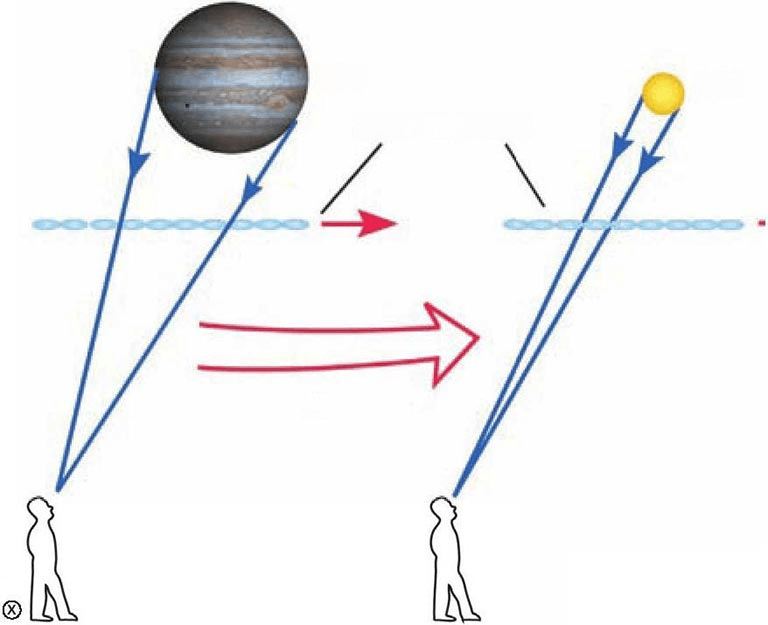
On clear nights, we see stars twinkling, as if they are "winking." What causes this? It's due to atmospheric turbulence. If you look at a scorching asphalt road in summer, you'll see the air above it appear to be churning like flowing water. When we look at distant objects through the air, they also appear blurry and shaky. The ancient Chinese gave this phenomenon a playful name: "wild horse." When the air is unevenly heated, its density changes, altering its refractive properties, acting like tiny lenses, thus causing this turbulence. Starlight is a point light source, and as it passes through Earth's atmosphere, it encounters many similar "tiny lenses." When these "tiny lenses" turbulent, the starlight sometimes disperses and sometimes converges, appearing to us as flickering, like "winking." Planets like Venus, being surface light sources, have angular inclinations larger than the scale of these unevenly dense air "lenses," making them less affected by atmospheric turbulence and generally not appearing to "wink."
Astronomers use "seeing" to characterize the degree to which atmospheric turbulence causes stars to "twist." Atmospheric turbulence affects the clarity of telescope observations of celestial objects, so professional observatories must be built in places where the air is relatively "quiet," that is, where "seeing" is good.