
What are the abilities of plants to resist drought?
According to their water demand, plants can be divided into aquatic plants, xerophytes, and mesophytes in between. There are generally three types of xerophytes 'abilities to adapt to extreme drought environments. The first is to use developed root systems to absorb water from deep in the soil. Although many drought-resistant plants are only 10 to 20 centimeters tall, their roots can grow into the soil several meters deep to find water. A long root can only absorb water in the root hair area near the root tip. To absorb water from dry soil, the root hair cell fluid of these plants must be very thick. Therefore, the root hair cells of these plants must be able to synthesize and accumulate high concentrations of small molecules to improve their water absorption capacity. Under drought conditions, small bubbles often appear in the conduits, blocking water transport. Many drought-resistant plants can quickly repair blocked ducts or regenerate new ducts to replace them. The century-old Populus euphratica in the Xinjiang desert relies on continuous renewal of conduits to ensure continuous water transportation halfway, thus adapting to the arid environment.
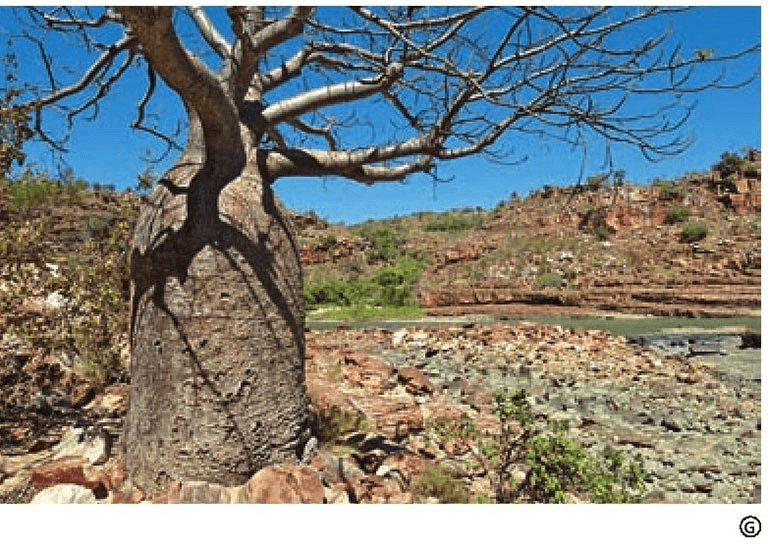
The second is to reduce water loss. Drought-tolerant plants often have a thick waxy layer on the leaf surface to reduce water loss, and some plants even close their stomata during the day. But how to absorb carbon dioxide for photosynthesis after closing the stomata? It turns out that these plants have evolved a special ability, which is to open their stomata at night when the temperature is low to store carbon dioxide in the body, and then use light energy to convert the stored carbon dioxide into sugar when there is sunshine during the day. For example, cactus and pineapples both have this ability and can survive even if it does not rain for a long time. The baobab tree in Africa has a very thick body and can store water. In evolution, they simply transformed their leaves completely into thorns, minimizing evaporation area, and using green fleshy stems to carry out photosynthesis.
The third is to avoid drought. There are some short-lived plants that can complete their entire life cycle during a short rainy season in arid areas. As a result, drought-tolerant plants in deserts are different from plants in rain-rich areas and either grow slowly or have a short lifespan.