
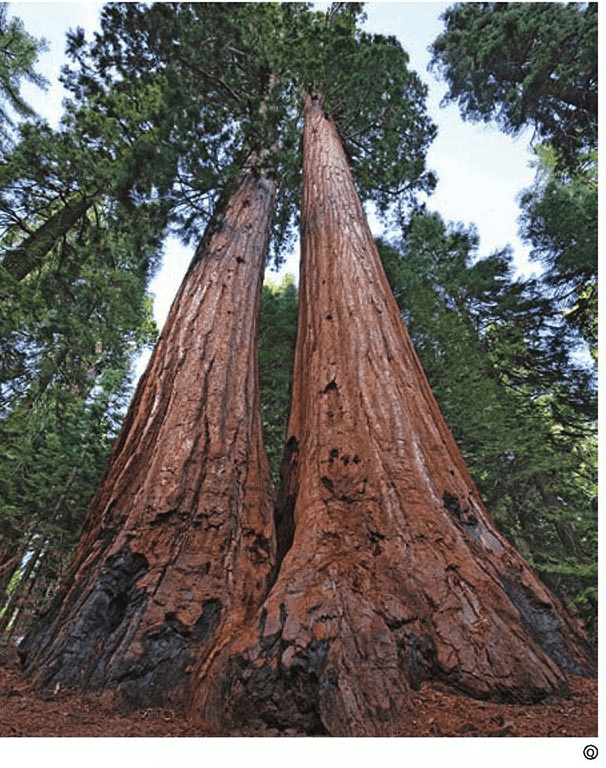
In the Rocky Mountain Valley of California, there is a group of 2000-year-old North American sequoias growing. The tallest of them reaches 112.7 meters high and the stem is more than 8 meters thick, which is taller than a 30-story building! How did the water "climb up" such a tall tree? Is it possible for it to grow taller?
Raising water from the roots to a 100-meter high canopy is not easy. First, water is absorbed by the root hair cells, transported to the xylem vessels, and then transported to the top branches and leaves through the vessels. This process can be imagined as a tug-of-war competition in which the crown uses water filaments in the conduit. It has to be "pulled" from above,"constantly" halfway, and "pushed" from the root.
So, can a hundred-meter-high tree generate enough pulling force? Scientists collected top branches at different heights to measure their water potential (pulling force) and found that the higher the branch, the greater the pulling force. The key midway is that it cannot break the water thread, because once the water thread is broken, bubbles will form in the catheter and block the transportation of water. The higher the crown, the greater the gravity and duct resistance of the water silk itself, the greater the pulling force the water silk has to bear, and the greater the possibility of being broken. Therefore, how high the water silk can ultimately be drawn depends on the firmness of the water silk, which is determined by the adhesion and surface tension between the water molecules. Scientists have found that sequoia trees have tough vessel walls and lower resistance to water than other tree species. We know that in such a tug-of-war competition, the pulling force must be greater than the sum of the gravity of the water thread and the resistance of the conduit to win. Under the same pulling force of the water silk, the water can be pulled higher because the resistance of the sequoia tree pipe is less.
As for thrust, when we cut off the lower part of the stem of a plant seedling, especially in sultry weather or early morning in summer, we often see liquid flowing out of the cut surface. This is root pressure (thrust). We can imagine that these 100-meter tall trees have deep root systems and high root pressure. It can be seen that the movement of water in a big tree is not a simple mechanical movement. In fact, the life activities of various cells play an important role.
Under the action of the earth's gravity, water has a certain weight. The higher the tree grows, the more water it will transport to the top, the heavier and more difficult. To a certain degree of difficulty, its top growth will be hindered by lack of water, and it will stop growing tall. The higher the branch, the smaller the leaves grow. The leaves at the top of the 112-meter-tall tree are as small as scales attached to the branch. These elderly trees are still growing taller, at a rate of about 25 centimeters per year. According to estimates, if the height is increased by another 15 meters, the top leaves will be completely dried up due to severe water loss. It is concluded that the limit height for tree growth is about 122 to 130 meters, which is also consistent with the highest record for trees in history.