
Human families have genealogy, which records the reproduction and deeds of important people of a family with blood relationship as the main body. If the entire plant kingdom is regarded as a large family, its "family tree" will become an evolutionary tree, recording the various groups in the large plant family and the relationships between them. Based on fossil data and combined with the similarities and differences in the structure of various plant bodies, scientists inferred the kinship between them and drew a tree diagram. This is the plant evolutionary tree, also called the plant systematic tree.
Between 4 billion and 3.5 billion years ago, the earliest organisms appeared on earth. They were prokaryotes such as bacteria and cyanobacteria. Cyanobacteria and some pigmented bacteria use sunlight to make nutrients and release a large amount of oxygen, gradually changing the nature of the atmosphere and preparing conditions for further development of organisms.
Between 1.5 billion and 1.4 billion years ago, organisms with eukaryotic cells began to appear, which may be flagellated organisms living in water. Over time, they evolved in three different directions: first, they developed into the plant kingdom along the autotrophic route with photosynthesis; second, they developed into the animal kingdom along the route of swallowing ready-made nutrients; and third, they developed into the bacterial kingdom along the heterotrophic route that absorbs nutrients. Among them, the original single-celled algae that carried out photosynthesis gradually evolved into a variety of algae plants, while the heterotrophic single-celled fungi gradually developed into various fungi.
Multicellular algae began to appear between 900 million and 700 million years ago. Various green algae, red algae, and brown algae thrive in large numbers in the ocean. The prosperous seaweed releases a large amount of oxygen, and part of the oxygen forms in the atmosphere. Ozone blocks ultraviolet radiation and creates conditions for plants to land.
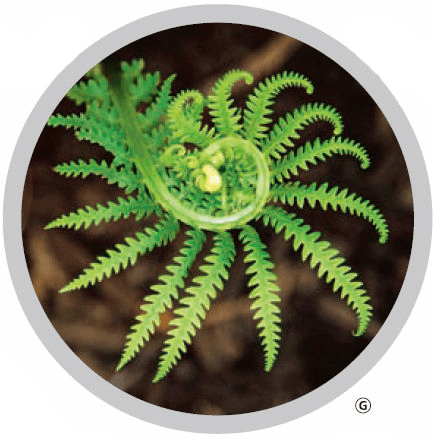
About 400 million years ago, a naked fern plant evolved from green algae and began to enter the land. Their descendants further developed in the direction of adapting to land life. After that, various ferns dominated the earth. For 140 million years. Primitive gymnosperms and angiosperms have also evolved among ferns, which are better adapted to dry land life. At the same time, bryophytes, which may have evolved from green algae, have successfully adapted to land life with their unique lifestyle.
From 260 million to 136 million years ago, gymnosperms replaced ferns and became the dominant plant group on the earth. Around 100 million years ago, the earth's climate changed, and there were several glacier periods since then. Most gymnosperms gradually disappeared, and angiosperms were replaced until today.