
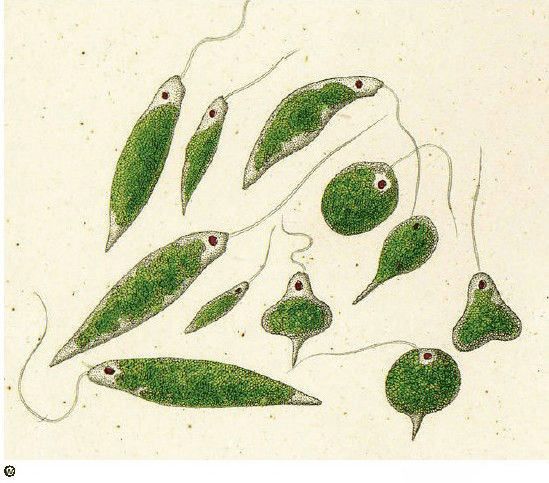
After rain in summer, small ponds often form on the ground. If the ponds last for many days, the water will often turn green. If we take a drop of green water and put it under a microscope, we can see many small green particles. Upon closer inspection, these small particles turned out to be single-celled organisms. There was a long flagella at the front of the fat body. Relying on the swinging of this flagella, they could swim happily in the water.
Does this single-celled organism belong to animals or plants? This simple question is a headache for taxonomists.
Zoologists call it an animal because they do not have the structure of cell walls and can move freely. This is clearly an animal. Although it has chloroplasts in its body, it only means that it is a relatively special type of animal and an autotrophic animal. Imagine, without these chloroplasts, who would think it was a plant? Therefore, zoologists issued it a "passport" from the animal kingdom and gave it an animal name-Euglena.
Botanists believe that although Euglena does not have the cell walls found in ordinary plants, it does have vacuoles and color carriers for photosynthesis that animal cells do not have. The chlorophyll a and b, as well as beta-carotene, lutein, etc. contained in the color carrier are also similar to higher plants. Although plant cells usually do not have flagella, during the reproductive period, the reproductive cells of all algae plants, as well as the male reproductive cells of fungi, moss, ferns, and some gymnosperms such as Tetsia chinensis also have flagella and can swim in water. As for Euglena, it may indicate that it is the most primitive plant and its cell wall has not yet evolved. So, the botanist issued it a plant "passport" and gave it a plant name-Euglena.
Nowadays, it is generally believed that organisms such as Euglena are the common ancestors of animals and plants.