
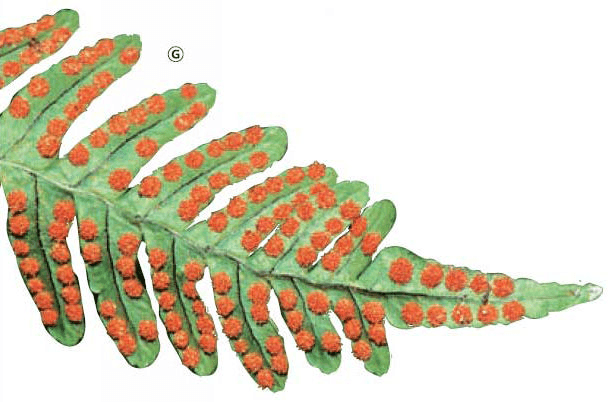
Ferns are a large group in the plant kingdom and have a very ancient history. Although they belong to relatively primitive spore plants, they have truly differentiated into roots, stems, and leaves, and a relatively complete transportation channel-vascular bundle has also appeared in the plant. Moreover, it plays a key role in inheriting the past and the future in the process of plant evolution from lower to higher. There are currently more than 12,000 ferns on the earth. Their shapes are unique and diverse, but most of them have a very interesting feature, that is, many small spots can often be seen on the back of the leaves, much like various Insect eggs, what are these? Botanists tell us that ferns do not bloom or bear fruit, and of course they have no seeds to use to reproduce their descendants. Ferns rely on spores to reproduce. Every summer and autumn, many egg-like dots appear on the back of their leaves. The scientific name of these dots is "sporangia group." Each sporangia group consists of many sporangia, which in turn contain countless spores. Fern spores are as tiny as dust and invisible to the naked eye. When they mature, the outer shell of the sporangia will automatically crack open and eject the spores inside. Spores that have left the sporangia can easily be scattered around with the wind due to their small and slight bodies. If they fall into a good and suitable environment, the spores can germinate there and grow new ferns.
The sporangia groups of most ferns are shaped like small dots of eggs, but there are also a few species that have other shapes. For example, the sporangia groups of Aphylla fern are like curved horseshoe, the sporangia groups of Clematis are hidden on the edge of the leaves, the sporangia groups of Lycopodium are like ears of wheat that stand upright, and the sporangia groups of Bird's Nest Fern grow thin and long along the veins. All in all, we see the "egg-shaped dots on the back of fern leaves, which are actually its reproductive organs-sporangia groups.