
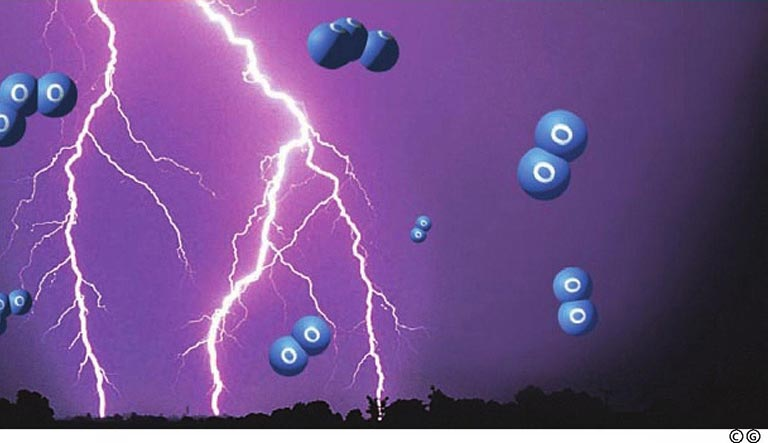
Spring is sung with birds, summer is sung with thunder, autumn is sung with insects, and winter is sung with wind. Thunder is nature's summer song.
On summer nights, dark clouds, heavy rain, lightning, and thunder often intersect each other and come together. The moist evening breeze after the rain drives away the sultry heat, and the breeze is blowing, bringing coolness to people.
After the rain, when you walk in the streets or fields, you will feel the air exceptionally fresh. There are two reasons for this: one is the downpour, which washes off the air with a "shower" and washes away most of the dust from the vagrants in the air; the other is that during lightning, a chemical change occurs-there will be a small amount of oxygen in the air and turn into ozone.
During lightning, part of the oxygen in the air chemically reacts and becomes ozone. Ozone is also composed of oxygen atoms, and is also the "sister" of oxygen: one molecule of oxygen contains two oxygen atoms, while the molecule of ozone contains three oxygen atoms.
When you walk into the motor room where the motor is ticking and close the window, you will smell a pungent stench in a while. This is because a large number of ozone molecules are mixed in the air and travel up your nose. The "cradle" of ozone generation is the motor, because in the motor, the voltage is very high, and the brushes in the motor always produce electric sparks. The surrounding oxygen is excited, and an oxygen molecule will decompose into two oxygen atoms. An oxygen atom and an oxygen molecule will form an ozone molecule (O). Ozone during thunderstorms is also produced in this way. Thunder is actually a positively charged cloud and a negatively charged cloud encounter each other and a discharge occurs. The charge carried by clouds is very high, and the potential difference is often as high as hundreds of millions to billions of volts, so huge sparks are often generated that turn oxygen into ozone.
High concentrations of ozone are light blue, smelly, and have strong oxidizing power. Ozone can bleach and sterilize. In some places, there is often a pungent smell in tap water. That is because tap water is disinfected and sterilized with chlorine, and the residual chlorine gas has a strange smell. If ozone is used to purify water, it can eliminate the strange smell left by disinfection with chlorine and improve water quality.
Thin ozone does not stink at all, but it gives people a fresh feeling. After a thunderstorm, a small amount of ozone fills the air, so it can purify the air and make it fresh.
In pine forests, there are many pine resins that also release ozone. Therefore, some nursing homes are located in pine forests because the air there is particularly fresh.