
Although living things have lived on the earth for millions of years, the age of Mother Earth, which carries so many lives, has never been known, troubling people on earth with strong curiosity. Without knowing the age of the Earth, it would be difficult to understand how this once-hot, molten planet gradually became so colorful and vibrant.
In many mythical stories, people attribute the formation of the earth and the universe to the omnipotent gods. Therefore, the earliest exploration of the age of the earth is often associated with mythical stories. In China mythology, Pangu opened up the world; Christian priests believed that God created the world in six days in 4004 BC, and those who accepted Christian teachings believed that the Bible's Genesis gave a reliable age for the earth.
The first person to try to scientifically study the age of the earth was British physicist Halley. He inferred the age of the ocean from the amount of seawater salinity replenished by river water and believed that it was equivalent to the age of the earth. British scientist Lord Kelvin hypothesized that the Earth originated from a hot molten sphere and that it would take 20 million to 40 million years to cool to its current temperature. These early useful explorations, although sketchy, at least tell people to break out of the shackles of the Bible: the earth is far more than a few thousand years old. These work often touched the sensitive nerves of the then dominant Christian Church, and many scientists were attacked by the Church and forced to abandon these pioneering research results. For example, the 18th century French naturalist and writer Buffon declared against his will that he would abandon the statement in his masterpiece "Natural History" that the formation of the earth contradicted the Biblical story.
The accurate measurement of the Earth's age by the isotope dating system is attributed to advances in physics in the 20th century. The famous physicists Curie and his wife discovered that certain radioactive isotopes (such as uranium) can automatically emit particles and turn into new elements (such as radium). This phenomenon is called radioactive decay. Isotopes emit a large amount of heat when they decay, which was the main reason why Lord Kelvin underestimated the age of the Earth. Under the earth's natural temperature and pressure conditions, the rate of radioisotope decay remains unchanged, which means that it is not affected by external conditions or to a certain extent by the element. Once the amount of radioactive isotopes (such as uranium) and the amount of isotopes (such as lead) formed by decay are measured in a geological sample, and then the decay rate determined by the radioactive isotopes can be used to accurately calculate the age of the sample. This is the basic principle of isotope dating.
Using isotope dating, geologists can determine when cooling magma and rock in the earth's crust formed. However, the earth went through a high-temperature magma sea stage in the early days, coupled with hundreds of millions of years of surface transformation, and the rocks originally formed on the earth can no longer be found. The rocks exposed on the earth's surface are obviously much younger than the age of the earth. So the best estimates of the Earth's age are not based on measurements of Earth's rocks, but from meteorites.
In the early days of the solar system, a large number of meteorites were formed with the Earth. They were composed of silicate minerals and iron-nickel metals and mainly existed in the asteroid belt between Mars and Jupiter. Due to their small size, meteorites cooled shortly after formation and stopped further evolution, so they faithfully recorded information about the formation of the solar system. It took only a few million years from the condensation of nebulous material in the solar system to the formation of the earth, which is just a short moment compared to the long history of the solar system. Therefore, if we know the age of the meteorites, the age of the earth is self-evident.
There is a special type of meteorite that contains the earliest solid particles formed when the solar system nebulae condensed, so it is very important for people to study the age of the solar system and the Earth. In recent years, someone has used the uranium-lead isotope method to measure the age of such solid particles. The results show that the age of these meteorites is 4.568 billion years.
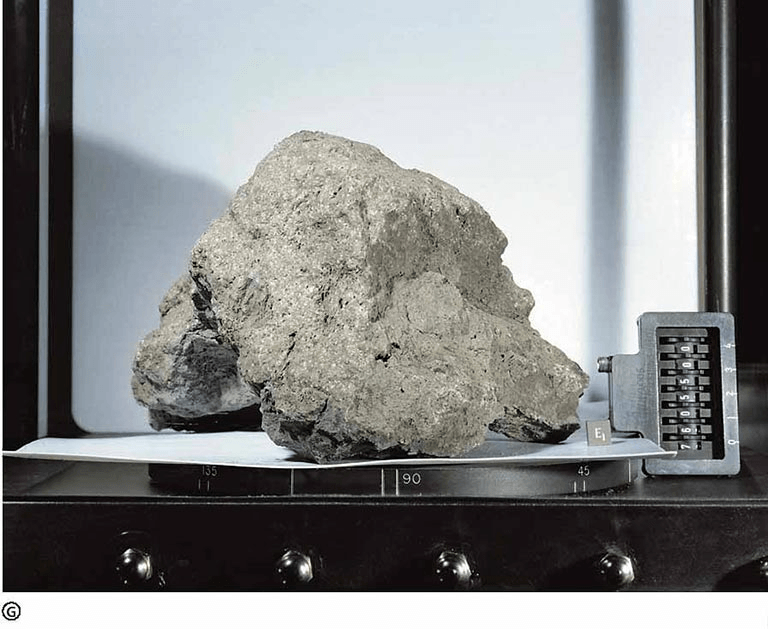
It is generally believed that the moon was formed by the collision of the primitive earth and the primitive planet, so some people thought that measuring the age of the moon can also infer the age of the earth. The Apollo program retrieved some rocks from the moon. After determination, the oldest lunar rock samples are consistent with the age of meteorites. It is inferred from this that the age of formation of the earth should be slightly smaller than 4.57 billion years.
The oldest preserved minerals on the earth are 4.4 billion years old. Oceans and continents may have appeared 4.2 billion years ago. The oldest preserved rocks were produced about 4 billion years ago. South and North China in China were put together 230 million years ago. If the history of the earth is regarded as 24 hours, animals appeared in the last 6 hours, land animals appeared in the countdown 2.5 hours, reptiles may have only appeared for half an hour, and human ancestors only appeared for about a minute.