
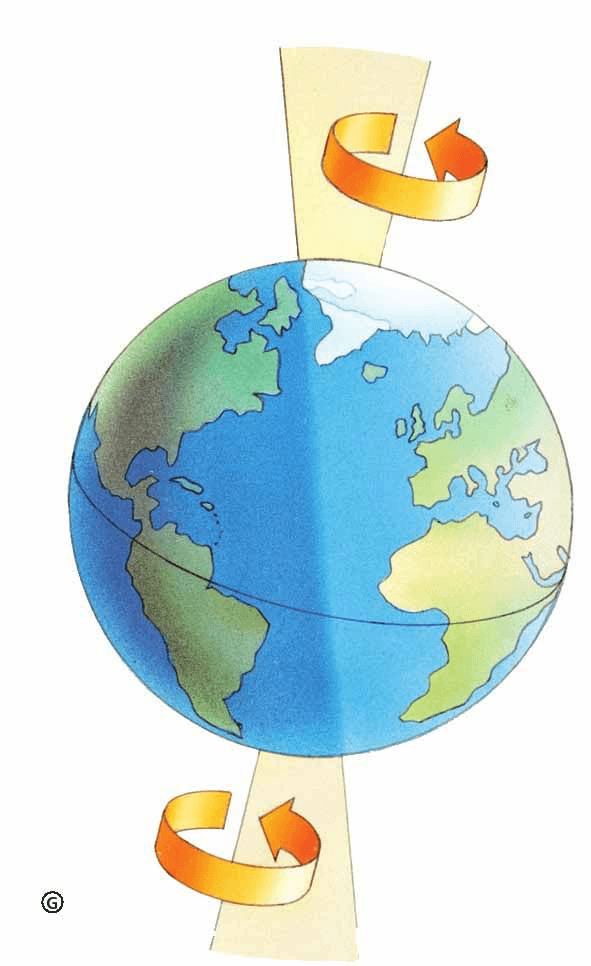
Why does the earth rotate? We experience the alternation of day and night every day, which is caused by the constant rotation of the earth, the earth under our feet. You may be wondering why we don't feel the earth turning. It was not until Copernicus proposed that the earth is also a planet that orbits the sun while rotating on its axis that people understood the principle of the alternation of day and night. So why does the earth rotate?
According to the currently popular theory of solar system formation, the solar system was born in a primitive nebula 4.6 billion years ago. This primitive nebula is not uniform everywhere, but has greater mass in some places and smaller mass in others. Since gravity is proportional to the mass of matter, under the action of universal gravity, the ones with less mass begin to rotate around places with more mass, gradually forming the sun, planets and various celestial bodies, and always maintaining the original angular momentum of the rotating body. Angular momentum is related to the radius, mass and linear velocity of the rotating body, and satisfies the law of conservation of energy. For a simple example, a figure skater rotates slowly when his arms are extended. This is because the radius of the rotating body increases, and angular momentum is conserved, and its linear speed will inevitably decrease; on the contrary, if his arms are retracted, the rotation speed will increase. It is precisely because of the wonderful law of "conservation of angular momentum" that today, all other planets and various celestial bodies are rotating. You might as well find a swivel chair and experience the relationship between rotation speed and rotation radius for yourself. But you may ask again: If a person rotates in a swivel chair will eventually stop because of the friction of the rotating shaft, will the earth's rotation also gradually slow down? Yes, the earth's rotation speed is constantly changing, but it is far more complicated than the reason why the swivel chair stops. The gravity of the moon and other celestial bodies will slightly "drag" the earth, slowing down the earth's rotation speed, and the sinking of heavy matter inside the earth can make the earth's self-transformation faster. In addition, the impact of asteroids and meteoroids can also change the earth's rotation speed.
Conservation of angular momentum can be used to explain changes in rotational speed of figure skaters