
The easiest part of the earth to understand is the upper crust, which is exposed to the surface, and can also be used to analyze the elements that make up various rocks and minerals. Therefore, in the exploration of the composition of the earth, people have the deepest understanding of the composition of the upper crust. Generally speaking, there are two ways to reveal the average composition of the upper crust: one is to measure the chemical composition of various rocks on a large scale, and then calculate the average composition of the crust based on their proportion in the crust. Some sedimentary rocks in the earth's crust have very small particles, such as shale, mudstone, loess, etc., and their chemical composition can represent the average value of the upper crust's composition over a large range. Therefore, measuring fine-grained sedimentary rocks in the earth's crust is another important method., especially for exploring certain elements that do not migrate with water during rock weathering, is very useful. These two methods have their own advantages. The former is accurate, but it requires a lot of work and requires measuring thousands of samples; the latter has a small workload, but it is inaccurate to estimate certain elements that are easily soluble in water (such as magnesium). Goldschmidt, the founder of modern geochemistry, made outstanding contributions in this field. China geochemist Li Tong also estimated the composition of China's upper crust.
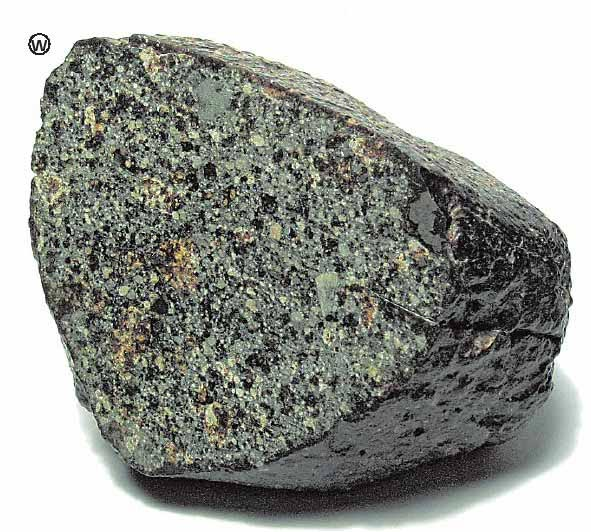
However, how to make a comprehensive and accurate measurement of the composition of the entire earth? The answer is, it depends on the sun and meteorites. The sun accounts for 99.7% of the mass of the solar system. By measuring the solar photosphere, we can know the chemical composition of the sun. Interestingly, except for some volatile elements such as hydrogen and helium, the chemical composition of the solar photosphere is very consistent with that of a meteorite with a chondrite structure. The interior of chondrites contains millimeter-sized particles, which are the earliest solid particles formed when the solar system nebula material condenses. Studying chondrites can infer the average composition of the earth. These meteorites were formed in the early days of the condensation of the solar system's nebula. If the earth comes from the aggregation of these chondrites, we can get a good understanding of the earth's average composition by studying meteorites.
On the periodic table discovered by chemist Mendeleev, the number of elements has so far reached 118. However, only 94 elements occur in nature. With these methods, we now know that the most important elements of the earth are iron, oxygen, silicon, and magnesium, accounting for more than 90% of the earth's total. They mainly exist in the crust, mantle, and core in the form of silicate minerals and metals.
Although other elements account for a very small proportion, the study of them can also reveal an important history of Earth's evolution. An interesting example is the mystery of platinum group metals. When the mantle and core are separated, almost all platinum group metals enter the core, so the content of platinum group metals is extremely low in the silicate part of the earth. However, current measurements of the Earth's mantle show that the content of these elements in the mantle is still quite high. Therefore, some scientists speculate that after the formation of the earth's core, an asteroid with a high platinum group metal content hit the earth, replenishing these important metal resources to the earth's mantle.