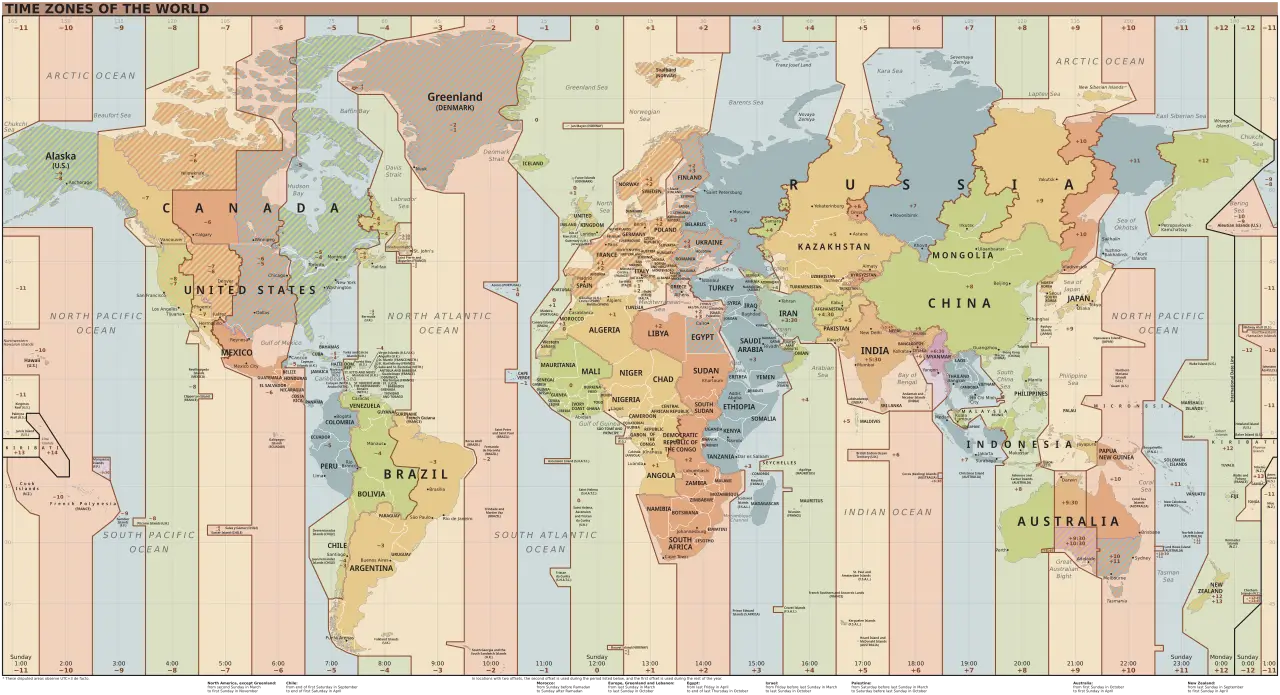
Why set a standard time zone In the early days, people used the sun to determine time. In the middle of the imaginary sky there is an arc running through the north and south, called the meridian. When the sun passes through the meridian, it is 12 o'clock local noon, which is called solar time. In 1675, in order to help long-distance ships determine their position, the Royal Observatory established "Greenwich Mean Time", which is the solar time passing through the Greenwich Observatory meridian. However, most people still use solar time in the city they live in as local time. This gradually became inapplicable after the advent of the railway era, because solar time differed by 4 minutes every 1° longitude, which made the train running times very chaotic. On December 1, 1847, British railway companies began to use "Greenwich Mean Time" as common time, which was also the establishment of the world's first "time zone" concept. Interestingly, the British government did not legislate on August 2, 1880 to make "Greenwich Mean Time" the official time. Therefore, old-fashioned British clocks often have two minute hands, one pointing to "Greenwich Mean Time" and the other pointing to local time. The idea of promoting time zones around the world at the Greenwich Observatory was first proposed by the Italian mathematician Filopanti, but it was not until long after his death that people noticed his work, so the proposal of time zones was attributed to the Canadian engineer Sir Fleming. Sir Fleming persisted in promoting his suggestion. Finally, at the International Meridian Conference held in October 1884, major powers adopted his suggestion, using the meridian passing through the former site of the Greenwich Observatory in the United Kingdom as the prime meridian, with 7.5 degrees in east and west respectively. The range is regarded as a zero time zone, and the east and west longitude are divided into a time zone every 15 degrees, with a difference of 1 hour. Around 1929, most countries on earth were already using the time in their own standard time zones, but it was not until after the Second World War that their respective standard time zones were corresponding to a few hours (usually an integer) forward or backward of "Greenwich Mean Time." The last country to adopt this time zone corresponding to Greenwich Mean Time was Nepal, which adopted a time 5 hours and 45 minutes faster than Greenwich Mean Time as its standard time in 1986. China has implemented a standard time zone system across the country since 1912. At that time, there were a total of five time zones, from the westernmost Kunlun time zone (5.5 hours faster than GMT) to the easternmost Changbai time zone (8.5 hours faster than GMT). In 1949, China began to adopt a single time zone, using Beijing time (the standard time of the East Eighth District) as the unified time across the country. However, people in Xinjiang still sometimes use the East Sixth District's area for informal occasions.
Why set a standard time zone?
This article focuses on "Why should we set a standard time zone?" It introduces that in the past, people relied on the sun to determine time. In the railway era, traffic chaos was caused due to solar time changing with longitude. Britain took the lead in adopting Greenwich Mean Time, and later, international conferences determined time zone division rules, and countries gradually implemented, China changed from multiple time zones to unified Beijing time and other core contents.