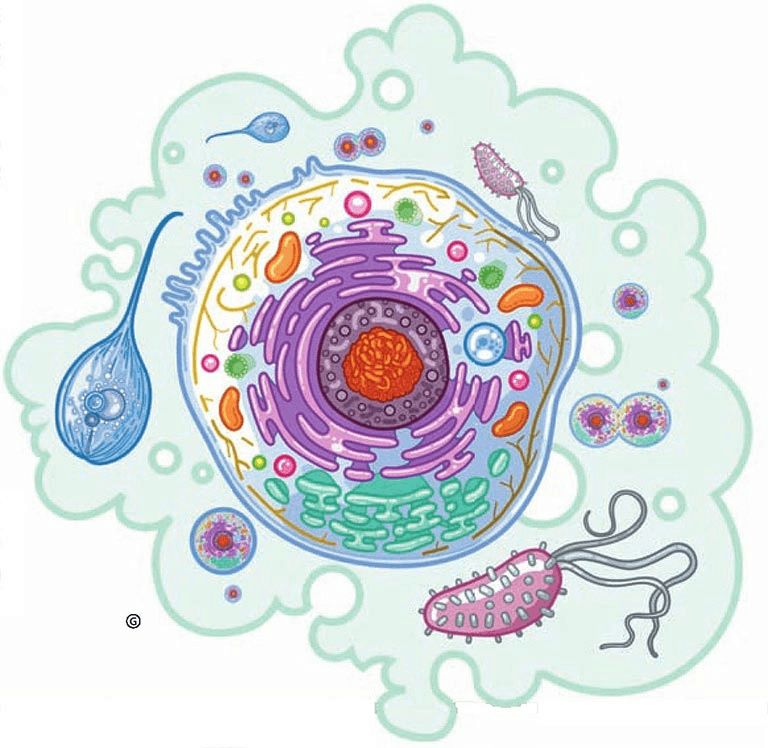
How did eukaryotic cells emerge There are two types of cells existing on the earth today: prokaryotic and eukaryotic. Prokaryote cells only have nuclear material. There is no membrane surrounding the nuclear material, and there are no organelles such as mitochondria and chloroplasts in the cytoplasm. Eukaryote cells have nuclear membranes surrounding nuclear material. In the 1960s, a scientist named Margulis had a sudden idea and put forward a bold hypothesis. He believes that when anaerobic cells, aerobic cells and autotrophic cells exist on earth at the same time (That is, cells that can undergo photosynthesis) After that, the anaerobic cells absorb the aerobic cells into the cells. The aerobic cells and the anaerobic cells coexist and coexist. The aerobic cells eventually become an organelle in the anaerobic cells. This organelle is mitochondria; If the anaerobic cells absorb the autotrophic cells again, when the autotrophic cells enter the prokaryotic cells that already have mitochondria, they can also coexist and thrive, then the autotrophic cells will become an organelle, and this organelle is chloroplast; Anaerobic cells with the ability to absorb not only other cells, but also their own cell membrane. When the absorbed cell membrane surrounds nuclear material, eukaryotic cells appear. Margulis's hypothesis of constant annexation is called the "endosymbiosis" hypothesis. However, if a hypothesis is not confirmed by experiments, it is not science. While scientists are simulating volcanic eruption environments to explore the origin of cells, research on synthetic living materials is also in full swing. At the end of the 20th century, the artificial synthesis of insulin and yeast alanine transfer nucleic acid had been successful one after another. At the beginning of the 21st century, life macromolecules such as proteins and nucleic acids were successfully synthesized. People believe that one day cells will be artificially "manufactured", and by then there will be a clear answer to how the first cells on earth were produced.
How did eukaryotic cells emerge?
This article discusses the emergence of eukaryotic cells, first explaining the differences between prokaryotic and eukaryotic cells, introducing the endosymbiosis hypothesis put forward by Margulis in the 1960s, and explaining that anaerobic cells absorb aerobic cells, autotrophic cells form mitochondria, chloroplasts, and ultimately constitute eukaryotic cells. The process also mentions the progress of artificial synthesis of living substances or helps answer the question of cell origin.