
How is the evolutionary direction of organisms determined? There are no identical creatures on earth, nor will there be identical individuals. Even identical twins will have differences of one kind or another. However, scientists have concluded that these various creatures living on earth have only one ancestor. Different creatures are like different branches on the same tree. They are different in shapes and sizes, but they share a common root. So, what is the basis for all living things on earth to have the same roots?
Whether they are extremely small and simple bacteria, or large elephants and whales, their bodies are all composed of cells, their life activities are carried out in cells, and their inheritance is also completed by cells. In addition, the life activities of all organisms are inseparable from proteins, and the transmission of their traits is inseparable from DNA. It is these identities between living things that led biologists to conclude that all living things have a common ancestor.
Research in comparative anatomy and comparative embryology also supports the conclusion that all organisms have common roots. But how can a common ancestor produce unrecognizable and diverse descendants? This question has troubled mankind a long time ago. Although there are different answers, the most convincing one is that all kinds of organisms are constantly changed and developed from common ancestors. The change and development of organisms are also called biological evolution, which is what we call "biological evolution."
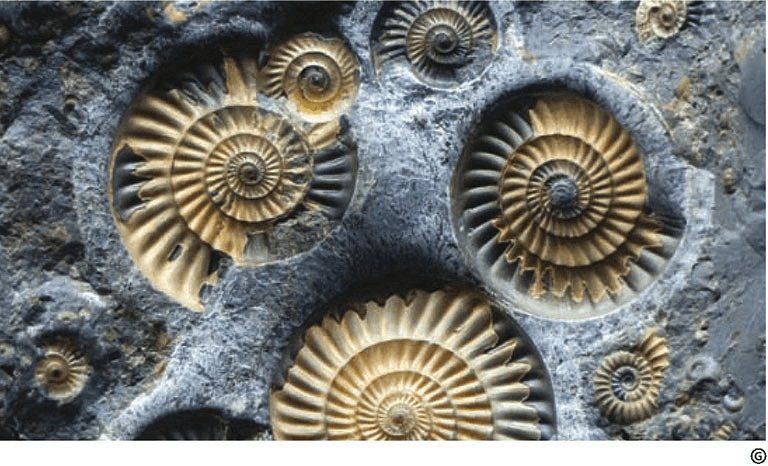
Ammonites are a type of extinct invertebrates, and they are also important indicator fossils indicating the age of strata. Geologists 'study of fossils confirms the validity of the idea of "biological evolution." The earth was formed 4.6 billion years ago. Geologists and paleontologists discovered bacterial fossils in the strata 3.6 billion years ago, and different types of fossils have been discovered in the strata 3.6 billion years later. Scientists found that the earliest animal fossils were invertebrates living in water, followed by fish, amphibians, reptiles, birds and mammals; the earliest plant fossils were aquatic algae, followed by ferns, gymnosperms, and angiosperms. Combined with the age of fossils and the types of fossils, scientists have seen the trend of biological development and change, that is, organisms on earth have changed and developed in the direction of simple to complex, aquatic to terrestrial, and low to high.
So, what drives the evolution of organisms? The most convincing answer was given by British scientist Darwin, who believed that the reason for biological evolution was "natural selection" or "survival of the fittest." Darwin saw from Malthus's "On Population" that population growth is faster than the growth of means of living, and agreed with this view. He believes that as long as any organism leaves two descendants per individual, as the number of their descendants increases, the total number of organisms will inevitably grow faster than the growth of living means. The only way to solve this contradiction is to engage in living resources among each other. Competition for living resources is called "survival competition" or "survival struggle."
In the "struggle for survival", the "brave" must win. Just like the relationship between wolves and rabbits, those who run faster in the wolf pack can easily catch the rabbit and survive, while those who run faster in the rabbit pack can easily save their lives. Wolves and wolves, rabbits and rabbits, wolves and rabbits are all competing for survival, and the winner of the competition is retained by nature. It can be seen that nature chose the winner in the competition for survival, referred to as "natural selection." Of course, it can also be believed that the winner in the "competition for survival" is suitable for nature, so "natural selection" is also called "survival of the fittest."
From the examples of wolves and rabbits, we can see that although they are both wolves, there are also fast runners and slow runners, and different individuals in the same species are mutant individuals. Darwin traveled around the world for five years. He saw widespread mutations among organisms. Although he did not know the specific reasons for the mutations, he clearly knew that it was the genetic mutations in various organisms that caused individual differences that led to competition for survival. It is precisely because of competition for survival that natural selection is triggered. It is precisely because mutant individuals suitable for nature survive that organisms develop "evolution."