
How did the world's first cells come into being? On April 28, 2012, the American Discovery News website disclosed a new research result by scientists at the University of Oslo in Norway: they discovered single-celled organisms 1 billion years ago. This oldest creature known to date was found in the mud of Lake Ass, 30 kilometers south of Oslo. It is 30 to 50 microns long and moves its body with the help of four tail-like flagella. This was a unique single-celled organism in the world at that time because it was neither an animal nor a plant, let alone a fungus or an algae. However, according to research on the origin of life, this creature is not the earliest cell in the world. The earth has a history of 4.6 billion years, and cells have appeared on the earth for at least 3.6 billion years. How did the world's first cells come into being? This is an ancient problem, and the best explanation is the chemical evolution hypothesis.
Scientists inferred that during the formation of the earth, a large amount of gas produced by violent changes in the earth's interior, along with frequently active volcanoes, broke through the earth's crust and sprayed into space, forming an atmosphere above the earth's crust. The newly formed atmosphere is filled with methane, ammonia, water vapor, carbon monoxide, carbon dioxide, hydrogen sulfide, etc., except for oxygen and nitrogen. Under the combined action of cosmic rays, radioactive materials on the earth, solar ultraviolet rays, lightning flashes, etc., inorganic molecules in the atmosphere gradually form small organic molecules such as amino acids, purines, pyrimidines, ribose, deoxyribose, and porphyrins. This is the first stage of chemical evolution.
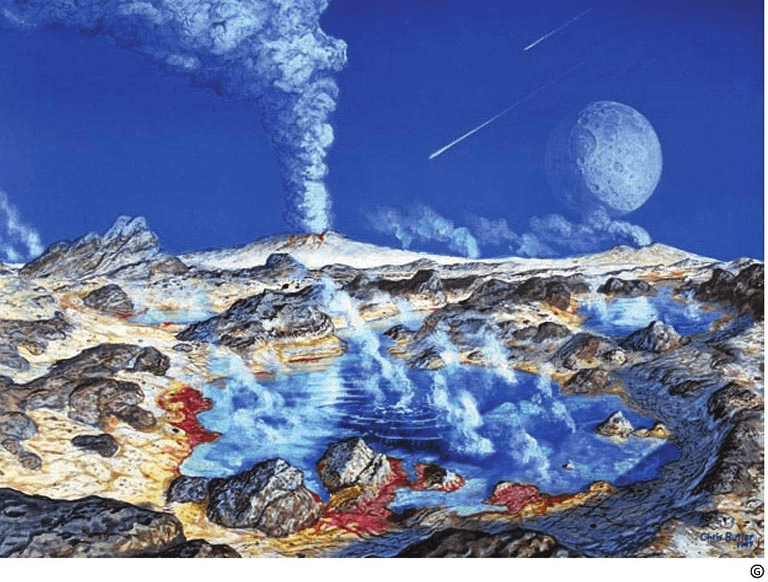
In the early days of the earth's formation, volcanic activity was very active, and boiling water ponds and boiling magma could be seen everywhere on the earth. Small organic molecules accumulate more and more after hundreds of millions of years of synthesis and accumulation. During this process, the temperature of the earth's surface gradually decreases, water vapor gradually condenses into water, and small organic molecules in the atmosphere gather into the primitive ocean with rainwater, and the small organic molecules in the primitive ocean become more and more abundant. At that time, because life had not yet appeared and there were no microorganisms that could decompose organic matter, organic molecules would not become moldy and deteriorate. The entire ocean was like a pot of "native soup" that was both nutritious and warm and clean. In the "native soup", organic molecules such as amino acids and nucleotides change from small molecules to organic macromolecules such as proteins and nucleic acids through "condensation" reactions such as dehydration and binding under long-term interactions. This is the second stage of chemical evolution.
When the concentration of organic macromolecules in the original ocean continues to increase, under the action of certain external conditions, these organic macromolecules are concentrated and separated from the ocean, and interact and gather into droplets. At this time, organic macromolecules can avoid disintegration due to the continuous "squeezing" of seawater into the interior of the molecule. The droplets formed by the aggregation of organic macromolecules are also surrounded by a boundary membrane. The boundary membrane is a combination of lipids and proteins and has the dual functions of "sentinel" and "pump". With this film, harmful substances from the outside cannot enter the inside of the droplet, while nutrients, on the contrary, will be "pumped" into the inside of the droplet even at extremely low concentrations. Such independent droplets are multimolecular systems. This independent multimolecular system can already exchange certain substances with the external environment. This is the third stage of chemical evolution.
The evolution of a multi-molecular system into the original cell is the fourth stage of chemical evolution, which is also the most complex and decisive stage. At this stage, macromolecules such as nucleic acids and proteins within the multi-molecular system are "in place". The nucleic acid is located in the center of the multi-molecular system, and the protein is located around the multi-molecular system. The central part is called the nuclear region, and the surrounding parts are the cytoplasmic region. The multi-molecular system after the nuclear and cytoplasmic division is the "prokaryotic cell".
After billions of years of development, the modern cell membrane structure has become very complex and precise: the phospholipid bilayer forms a solid wall that isolates the environment inside the cell from the outside world, and the cell membrane is also inlaid with many proteins, which shoulder heavy responsibilities such as material exchange, energy conversion and signal transmission.