
On earth today, there are more than 1.5 million species of animals, more than 300,000 species of plants and more than 200,000 species of microorganisms. From mountains to plains, from deserts to polar regions, from the air to the ocean, there are traces of life everywhere. Today's earth is really a magnificent and colorful biological world. However, more than 3 billion years ago, there were no flowers, trees, humans, birds and animals on the earth. Everything was dead and desolate.
So where does life come from? Regarding this issue, some people in ancient my country claimed that life was created by God, while others claimed that it was created by heaven. More Westerners believed that life was created by God. Whether it is "creationism","natural creationism" or "God creationism", they all have one thing in common, that is, those created creatures will always remain the same. Is this really the case?
These are universally recognized facts that tadpoles turn into frogs, babies grow up, and fruit trees blossom and bear fruit. Although Africans, Asians, and Europeans belong to the same species, there are obvious differences due to different regions. Differences of one kind and another will also appear in different regions.
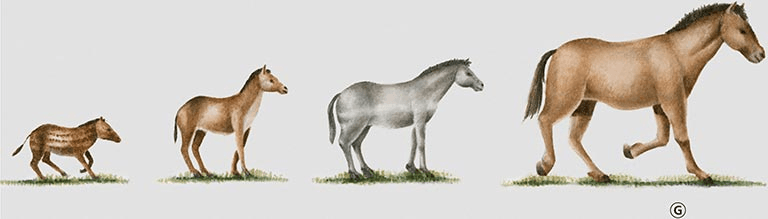
From a tadpole to a frog, its appearance will undergo tremendous changes. The remains, relics and relics of organisms left behind in different geological times are called fossils, and the organisms that have existed in different geological times and are still alive are called living fossils. Because living fossils are among the few organisms that survived the catastrophe, they are also called remnant organisms. The closest geological time to today is two to three million years old. Shizuma was about the same size as a dog. During evolution, the horse's body shape changed and the number of toes decreased. The fossil record shows that some organisms that once existed on earth are no longer present, while some organisms on earth have never appeared before, indicating that the types of organisms have changed over time. In addition, the past and present lives of relics will also change in terms of shape and size. For example, the armadillos in South America are not what they used to be, with obvious differences in length.
By comparing the same species of organisms on islands and continents, we can also see the changes in organisms. For example, 1000 kilometers from the west coast of South America, there is an archipelago called the Galapagos. When the islands were first formed, there were neither animals nor plants. Later, some creatures on the South American continent migrated to live on the archipelago. Over time, some creatures that passed down on the island became different in terms of body shape and size compared with their counterparts on the South American continent. For example, the giant turtles and ground finches on the archipelago were significantly different from the giant turtles and ground finches on the mainland. The neck length and shell shape of the giant turtles, the size, living habits, and the length and thickness of the beak of the ground finches were significantly different.
Conversely, if animals and plants had never changed, there would be no poultry, livestock and crops like today. Because the latter was changed from wild species with human intervention. Today's chickens evolved from wild chickens; today's pigs evolved from wild boars; today's rice is transformed from wild rice that looks similar to grass; today's corn ancestors are wild grass. The history of the formation of poultry, livestock and crops is a history of humans skillfully utilizing changes in birds, beasts and wild plants. If animals and plants would never change, no matter how smart humans were, they would not be able to create poultry, livestock and crops.
Not only is the population of organisms changing, but individual organisms also change during their life cycle. Mammals must live in the mother's body for a period of time before birth. The embryos of mammals such as humans, rabbits, cows, and pigs all start from a cell called a fertilized egg. However, during the development of mammalian embryos in the mother's body, similar characteristics such as gill clefts and tails appear. This phenomenon shows that although different types of mammals are now different in appearance and size and were once relatives in ancient times, if they continue to look forward, they will find a common ancestor.
A fertilized egg of a mammal becomes a complete small animal. Although the changes are extremely complex, it does not take a long time. For example, in humans and cattle, after about 10 months, a fertilized egg that is invisible to the naked eye becomes a small life with clear physical characteristics. This shows that mammals change rapidly during this time in the mother.
Numerous facts show that not only is the same organism changing, but also the types of organisms on earth. So where did the creatures come from? There is still no complete answer to this question. But we are convinced that as mankind continues to conduct scientific exploration, not only will the causes of biological changes be revealed to the world, but even the mystery of where life came from will eventually be solved.