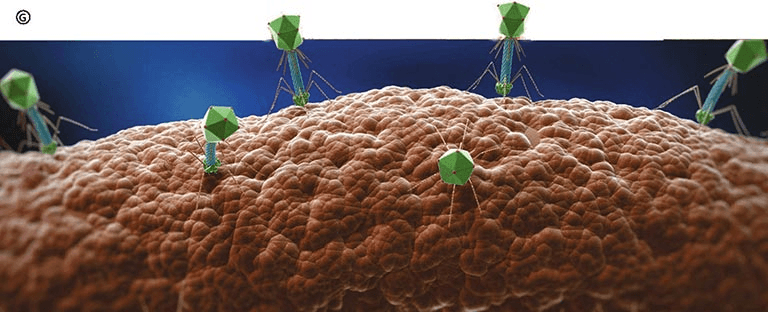
In the vast nature world, are there objects that are both inanimate and living? Yes, this is a strange virus. A virus is a complex in which a protein is wrapped around nucleic acid. This complex outside the cell is just like when nucleic acid and protein exist alone. It has neither metabolic nor reproductive ability. Of course, it has no genetic variation and adaptability to the environment. It is lifeless and non-living matter; but once it enters the cell, it becomes a living object. Viruses that can only enter animal cells are called animal viruses, viruses that can only enter plant cells are called plant viruses, and viruses that can only enter fungi or bacteria are called fungal viruses and bacterial viruses respectively. Bacterial viruses also have a name called "bacteriophage", which is famous all over the world for its ability to "swallow" bacteria. Phages adhere to the surface of Escherichia coli and scramble to inject their own DNA into the Escherichia coli. There is a type of phage that specializes in "feeding" on Escherichia coli. Its tail immediately adheres to the cell surface of the bacteria, and at the same time secretes an enzyme that can dissolve the cell wall, making a hole in the surface of the bacteria; then the DNA in the phage passes through this hole and drives straight into the bacteria, while the protein of the phage remains outside the bacteria. After the DNA of the phage enters the bacterium, it immediately uses various substances in the bacterium to synthesize new substances according to its own needs. New substances include phage DNA, phage proteins, substances that help assemble phage proteins and phage DNA into phage, and substances that destroy bacteria and release phage. In this way, after the DNA of a phage enters the bacterial body, the phage reproduces more phage through the conversion of old and new substances, that is, metabolism, and genetic variation and environmental adaptation also occur during the reproduction process. It can be seen that after entering the cell, the virus really becomes a veritable organism.
Why is the virus both lifeless and alive?
Viruses have the characteristics of neither life nor life: Viruses are protein-wrapped nucleic acid complexes. They have no vital abilities such as metabolism, reproduction and genetic variation outside the cells, and are non-life; after entering cells, they can use host materials to metabolize and reproduce, appearing life characteristics, becoming a living body.