
A person, an elephant, or even a grass contain many cells, so they are also called multicellular organisms. However, among the numerous cells of any multicellular organism, no matter how different they may be in shape, function, or physiological characteristics, the genomes are the same in their nuclei. For example, our human body consists of 10^12 to 10^14 cells. All human cells have 2 genomes, and each genome has 23 chromosomes. Why are the genomes the same among many cells in the same organism? The simple answer is that all cells in an organism are produced from the same fertilized egg through constant mitosis. Mitosis, as the name suggests, means that a filamentary pattern appears during cell division. Observation under a microscope can be seen that the fertilized egg will appear in a fusiform pattern at a specific stage of division. These filaments are called spindle filaments.
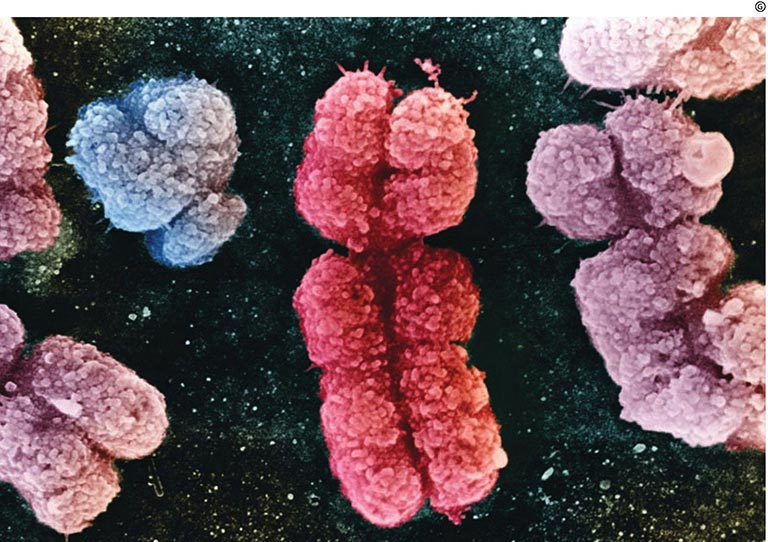
When a fertilized egg or other cell undergoes mitosis, the chromosomes must first be replicated, and each chromosome must change from one to two. After chromosomes are replicated, each chromosome is concentrated in the center of the cell, which is called the equatorial plane. At this time, the spindle composed of spindle filaments can be clearly seen under the microscope. Next, the centromere opens, or the centromere splits into two, making the sister chromatids that were originally connected together become independent chromosomes. Then the chromosomes that evolved from the sister chromatids will be divided into two poles of the cell. When all chromosomes are divided into two poles, if in animal cells, a depression will appear in the middle of the cell, dividing one cell into two cells; if in plant cells, a cell plate will be formed in the middle, dividing one cell into two cells.
The mitosis process begins with the fertilized egg, and mitosis of all cells is roughly completed according to these steps. The cells obtained after mitosis and the cells before division both contain the same genome. The fundamental reason is that the chromosome is copied once and the cell is divided into two. So, why do cells with the same genome differ in shape, function, and physiological characteristics? This is the result of cells with the same genome gradually evolving in different directions. The process of cells with the same genome evolving into different types of cells is called cell differentiation in life sciences. Nerve cells, smooth muscle cells, islet cells, reticulocytes, etc. in the human body are all products of cell differentiation.