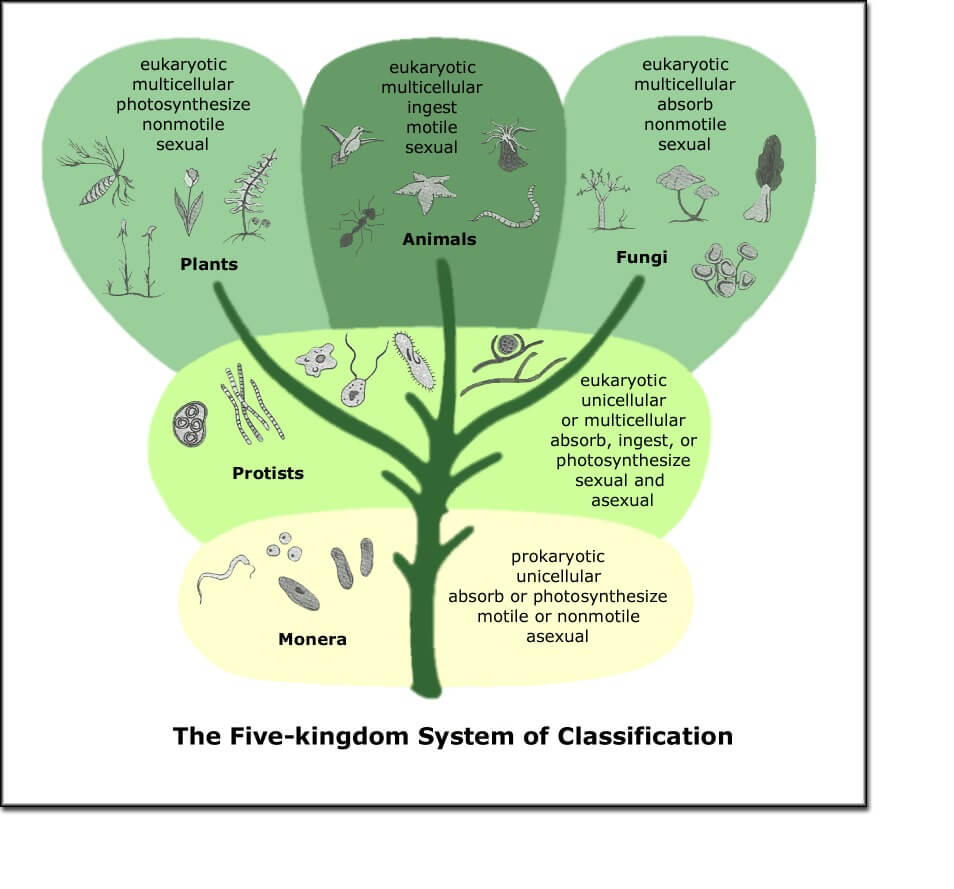
Why does the classification system of organisms change? Before the invention of the microscope, Lin Nai for the first time divided life on earth into two worlds: the plant kingdom and the animal kingdom. According to Lin-Nai's demarcation method, plants have green leaves that can carry out photosynthesis. Generally, they have roots tied in the soil and cannot move freely. Those organisms that can move freely, cannot synthesize, and feed on plants and other organic matter are all classified into the animal kingdom. Although fungi cannot carry out photosynthesis, they have roots in the substrate and cannot move freely, so they are also classified into the plant kingdom by Lin Nai. After the invention of the microscope, people were not only pleasantly surprised to see a large group of single-celled microorganisms under the microscope, but also discovered many other single-celled organisms, such as Euglena with chloroplasts. In 1866, the German naturalist Haeckel merged bacteria in prokaryotes, cyanobacteria and fungi, protozoa, lower algae and single-celled group organisms (such as sponges) in single-celled eukaryotes into the realm of protists. As a result, the biological classification system became the Three Realms. By 1969, American biologist Whitaker and others proposed five definitions. In the five-boundary theory, prokaryotes are listed as a separate kingdom, and fungi are separated from the plant kingdom to become the fungus kingdom. This expands the realm of organisms into the realm of prokaryotes, protists, fungi, plants and animals. These five realms are the world of animals. In 1974, Riddle believed that the protozoa kingdom was not a natural group and was highly subjective and arbitrary, so he included all members of the protozoa kingdom into the fungus kingdom, plant kingdom and animal kingdom respectively, so that the five realms became the four realms. As we enter the 21st century, people are extremely active in research on viruses. Some people have suggested that viruses are non-cellular organisms, a very unique and extremely important biological group, and should be independently bounded, that is, the virus world. But many people believe that to this day, the origin of the virus remains a mystery, and the biological classification system is a historical summary of biological evolution, so it is too early to establish a new portal for the virus.
Why does the classification system of organisms change?
This article introduces the process of continuous adjustment of the biological classification system with the development of cognition: from Linnai's two-boundary classification, to Haeckel's proposal that the protozoa realm should form three realms after the invention of the microscope, to Whitaker's five-boundary theory and Riedel's four-boundary adjustment, there is still controversy in the academic community in the 21st century about whether viruses are independently bounded, reflecting that the classification system is based on scientific understanding of biological evolution.