
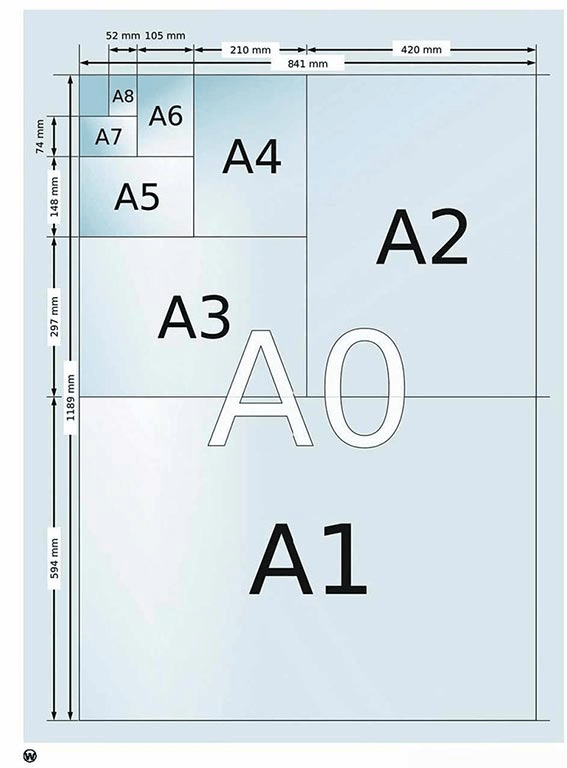
In daily life, we often deal with A4 paper, whose standard size is 210 mm × 297 mm. Calculate its length-width ratio: √2:1. If we take two A4 papers and join them along their long edges, we can get a large paper with dimensions of 420 mm × 297 mm. Calculate its length-width ratio again: the ratio between the large and small papers remains basically unchanged, and it is also quite close to √2:1. Is this a coincidence? In fact, if a piece of paper has an ideal length-width ratio of √2:1, it will "inherit" its length-width ratio to the "next generation". Specifically, the initial large rectangular paper has a length-width ratio of √2:1. When this large paper is folded along its long edge, the resulting small rectangular paper still has a length-width ratio of √2:1, that is, it is still √2:1. This operation can be repeated multiple times, and the A series of papers is obtained in this way. In the A series of papers, the original paper is called A0, and its size specification is 1189 mm × 841 mm. Simple calculations show that its area is close to 1 square meter, and its length-width ratio is very close to √2:1. Folding and cutting the A0 paper along its long edge, we get A1 paper, with specifications of 841 mm × 594 mm. Repeating the same operation on A1, we get A2 paper, with specifications of 594 mm × 420 mm, and so on, thus obtaining the A series of paper models. So what are the practical benefits of choosing paper with a length-width ratio of √2:1? Simply put, using paper with this property, there will be no leftover scrap edges, which can avoid waste, reduce the cost of re-production and improve work efficiency.
In addition to the A series, there is also the B series of paper that we commonly use now. For the B series, the specification of the original B0 paper is 1456 mm × 1030 mm, which is determined according to a length-width ratio of √2:1 and an area of 1.5 square meters. By repeatedly folding and cutting it, we can successively obtain B1, B2 and other series of B-model papers.