
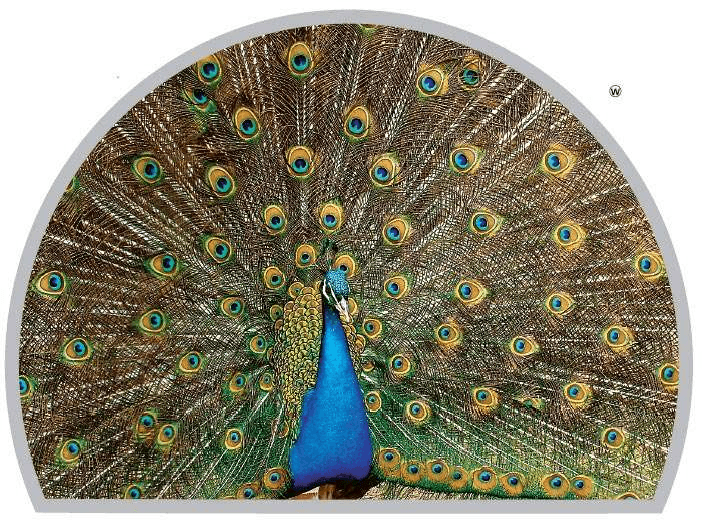
Why are peacock feathers so colorful? Peacock is perhaps the most colorful and beautiful bird in the world. The male peacock drags long tail feathers, and the tail of each feather is decorated with "eye circles" composed of small branches of blue, green, yellow, brown and other colors. When the screen is opened, it reflects a bright and dazzling luster. The source of the brilliant color of peacock feathers has aroused great interest among scientific giants such as Hooke, Newton, and Michelson.
Color in nature is mainly produced through two ways: one is pigment color, and the other is structural color. Pigment color is the most common and common color, derived from the fact that pigments selectively absorb light of certain colors and reflect or scatter light of other colors. The origin of structural color is completely different from that of pigment color. It is caused by the interference, diffraction or scattering effect caused by the interaction between natural light and optical structures. Its characteristic is iridescent effect, that is, its color will also change accordingly as the observation angle changes. The color of peacock feathers is a typical example.
The peacock used an electron microscope to observe the microstructure of the feather branches of different colors of peacock feathers. It was found that the cortex of the feather branches was an orderly optical structure, composed of an array of periodically arranged melanin pillars inlaid with keratin bases, and there was also an air hole in the middle. Array.
The optical structures in the branches of different colors of peacock feathers are very similar. The main difference is the different spacing between the melanin pillars. The spacing between the melanin pillars in the blue, green, yellow and brown pinchlets is approximately 140, 150, 160 and 185 nanometers, respectively; it is this small difference that leads to the different colors. This optical structure (also known as "photonic crystal") produces the combined effect of interference and scattering, forming multiple colors. For example, the small feather branches that appear green are due to their strong reflection on green light, and other colors. Light can pass through.
Peacock feathers also have an iridescent effect. If we look obliquely, we will find that the color blue-shifts. For example, green feathers turn blue and yellow feathers turn green. This iridescent effect is due to the selective light of the optical structure. The reflected color blue-shifts accordingly with the change of observation angle.
The strategy of adjusting color by peacock feathers is very exquisite, that is, using the optical structure of the feather branch cortex and slightly changing its structural parameters to obtain different color structural colors. Structural colors have wonderful characteristics that pigment colors do not have, such as rainbow color luster, high brightness and color saturation. Changing the structure can change the color and never fade. Therefore, structural colors have important application prospects in biomimetic preparation of new environmentally friendly pigments, displays and other fields, and also provide inspiration for scientists to develop new photonic structural materials and devices.