
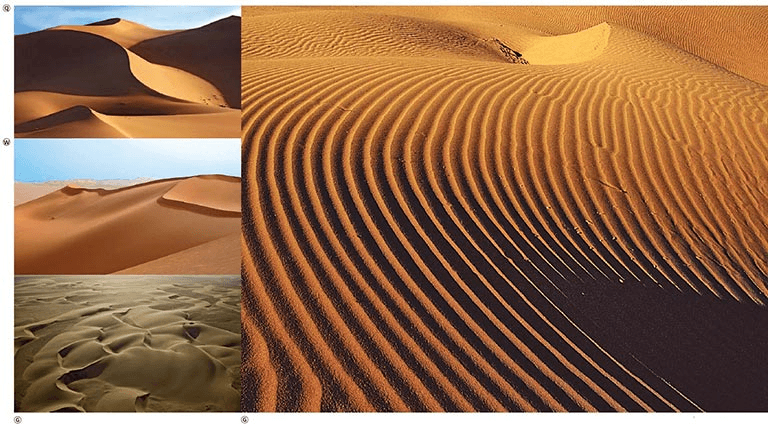
Why do sand dunes all over the world grow almost? One-third of the earth's land area is covered by deserts, and the most common landscape in deserts is undoubtedly endless sand dunes. However, what is surprising is that although the scenery of the desert is ever-changing, the sand dunes in the desert are only composed of a few basic shapes.
Deserts are often located in dry, relatively flat areas. Due to the lack of water in the desert, the sand is scattered very widely and will not stick to one body. Due to the terrain, these scattered sand has become the protagonists in the desert. In such a simple situation, a large amount of sand grains form sand dunes under the action of the wind. After research by scientists, there are only a few common sand dune shapes. The crescent shape is a typical sand dune shape. Under the influence of the wind, the surface of the sand is no longer flat. At this time, the sand on the windward side is constantly transported up, the sand on the leeward side is not affected, the sand below is silted up as the sand dunes slowly move forward with the wind, and the sand on both sides is streamlined under the action of the wind. After a period of time, sand dunes similar to crescent moon were formed. In addition to crescent-shaped sand dunes, there are also transverse sand dunes that are similar to waves, and linear sand dunes that are formed downwind like field ridges (we often see grooves on the surface of large sand dunes, which are small linear sand dunes). Under some different sand textures, parabolic dunes similar to reverse crescent dunes can also appear due to the friction between sand and different wind forces.
The deserts we see every day are composed of these types of sand dunes. In fact, the sand on the sea floor forms a similar shape to the sand on land deserts. After studying the sand dunes on earth, scientists turned their attention to space. American scientists found clear sand dunes on Mars in photos returned by the launched Mars probe. Analyzing the shape and movement characteristics of these sand dunes can also provide clues for studying the climate and surface conditions on Mars.