
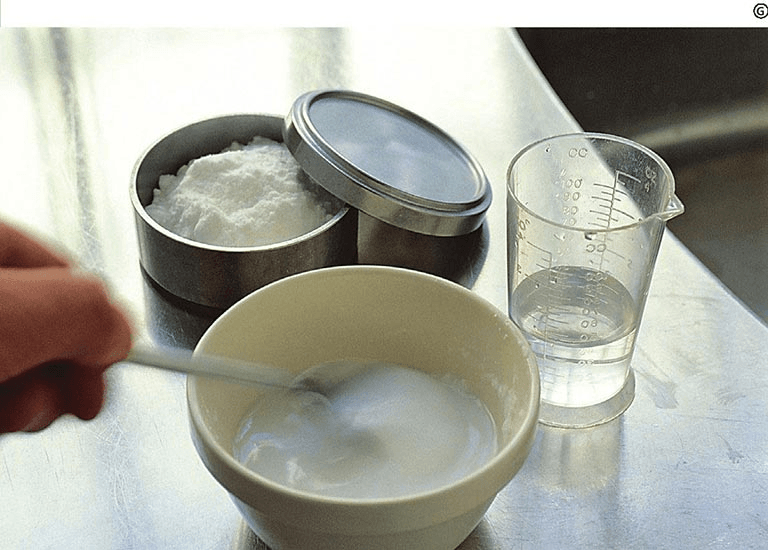
Why is it easier to stir the water, but the batter becomes more difficult to stir? In life, we may encounter such a situation. If there is a bowl of water and use chopsticks to stir it quickly in a certain direction, it will feel easier to stir, and the water in the bowl will simultaneously show a concave center. whirlpool. However, if we add flour to this bowl of water, the results will be different. If we stir again at this time, we will find that the more we stir, the more difficult it becomes, and the batter will climb up the chopsticks. Why is this contrast?
Pole-climbing phenomenon occurs when mixing batter. In fact, in the classification of fluids in soft condensed matter physics, water and batter are two fluids with different properties, namely Newtonian fluids and non-Newtonian fluids. Many common fluids in nature such as water, alcohol, and air are called "Newtonian fluids." For most low-molecular fluids (with small molecular weights), due to their isotropic characteristics, the viscosity coefficient remains basically fixed. This type of fluid is Newtonian. The viscosity coefficient of non-Newtonian fluids changes with the shear rate. The higher the shear rate, the stronger the viscosity. In other words, if you want to stir such fluids quickly, you have to use more effort, and the faster the speed, the more strenuous it will be. Such non-Newtonian fluids include solutions, suspensions, etc. of many polymers (very large molecular weights). Batter is produced by adding flour to water, and flour is a natural polymer compound, so batter is a non-Newtonian fluid. Therefore, when we stir the batter, the faster we stir, the faster the viscosity of the batter will increase, and the result will naturally become more difficult to stir.
At this point, we can answer the above questions more specifically. For water, when we constantly stir it with chopsticks, water molecules will spread to the outside due to centrifugal force, so there will be less water in the center and look like a concave vortex, which also leads to The more stirred, the easier it is. However, for batter, flour polymers form an anisotropic structure during agitation. The polymer chain will be stretched and wrapped around the chopsticks. The greater the shear force, the higher the degree of stretching, and the polymer chain itself will produce stronger resilience. This causes these flour polymers to squeeze towards the center, forming a "pole climbing phenomenon"(also known as the Weisenberg effect), which makes it more difficult to stir.