
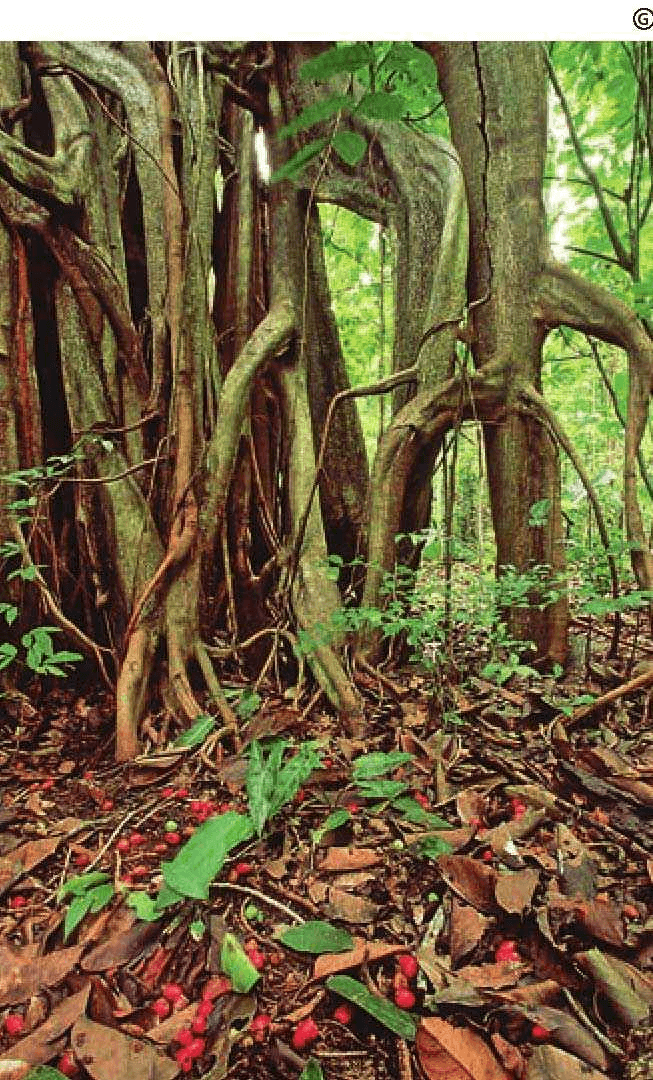
In dioecious cryptogamic plants, the female and male flowers grow on different plants, and it seems difficult to spread the pollen from the male flower to the stigma of the female flower. So how do they reproduce? It turns out that they rely on insects that co-evolved with plants. The relationship between fig wasps parasitic on banyan trees and banyan trees is an example of a particularly exclusive evolutionary relationship. It is now known that 98% of banyan species maintain a single-minded relationship in which one banyan species is pollinated by only one fig wasp. A fig wasp only pollinates one fig tree in its life, and they maintain a strict one-on-one relationship with each other. Therefore, fig and pollinating fig wasps have become typical examples for scientists to study biological mutualism and co-evolution.
Generally speaking, plants that rely on insects to spread pollen have beautiful or sweet flowers that can attract insects to pollinate them. However, although trees in the genus Ficus also rely on insects to pollinate, they do not have beautiful flowers. Its flower is even much smaller than a full stop in our books. Many flowers are clustered in an expanded inflorescence to form a secret head. Because the flowers are small and tender and easily bitten and destroyed by insects, after long-term evolution, the inflorescences of the banyan tree wrap all flowers and protect them. This is a big advance in evolutionary history, but it also raises the question, who will pollinate them? Insects such as beetles, flies, butterflies, bees and mosquitoes have different mouthparts, but the individuals are too big to pollinate them. In the end, a special insect came into being: the fig wasp.
Take a dioecious banyan tree as an example. The female plant has only female flowers, and the male plant has male flowers and gall flowers. Gall flowers are neutral flowers specialized in female flowers. They cannot bear fruit and are only used for laying eggs by fig wasps. The gall flower stigma is very short, which is just right for the length of the ovipositor of fig wasps, allowing it to easily hatch a new generation of fig wasps. The fig wasp lays an egg in the ovary of each gall flower. After a short incubation, the larva is born. It will occupy the gall flower ovary. At this time, the banyan tree will continue to feed nutrients to the larvae just like feeding its own children. The banyan tree parasitized by larvae only blooms male flowers but not bears fruit, and almost all its photosynthesis products are used to cultivate hundreds of thousands of young bees. So, how does the banyan tree itself reproduce? Perhaps it is fate that tricks people, or perhaps it is nature's magic plan, the banyan tree's selfless dedication has been unexpectedly rewarded. Some young bees went astray and flew from the male banyan tree to the female banyan tree. At this time, only the female flower was waiting for them. The female flower style was very long. After the young bees got in, they could not lay eggs because the ovipositor was too short. During the process of searching for the spawning site, the pollen on their bodies accidentally touched the long stigma of the female flower, and pollination was completed in this interlocking coincidence. Those fig wasps that were originally looking for gall flowers but went astray died in the inflorescences after exhausting their physical strength. Although they did not complete the task of reproduction according to their biological instincts, they magically acted as matchmakers for plants. The most wonderful thing is that every spring, when fig wasps mature in large numbers and fly out to find gall flowers, the branches of the banyan tree are covered with female inflorescences, and the gall flower inflorescences are less than 20%. That is to say, the banyan tree forces the vast majority of fig wasps with a precise time difference. They only pollinate and not lay eggs. This seems to be a kind of unnecessary sacrifice and free dedication. In fact, it is not the case. The banyan tree produces seeds due to pollination by fig wasps. The banyan tree, which has grown up after several years, provides a habitat and breeding place for the descendants of fig wasps.
In the long process of evolution, the banyan tree evolved from monoecious to dioecious; the male flowers evolved from scattered around to concentrated in the mouth of the inflorescence; the female flowers differentiated from a lower stage that can both bear fruit and support larvae into a gall flower specially for fig wasps to inhabit. Because male bees live in closed, dark inflorescences all their lives, their wings, eyes and walking feet degrade, and their body color fades. Female bees develop structures that can flatten their heads and drill into the inflorescences. After mutual adaptation and mutual selection, the "fig and bee" form a one-to-one exclusive symbiotic relationship, so that they "both prosper when they combine, and both die when they separate." The tiny banyan wasp and the huge banyan tree help each other and rely on each other. They are indispensable. There are more than 700 banyan trees in the world, and more than 100 in China. Each of them has its own unique banyan wasp, which makes us sigh at the natural creation!