
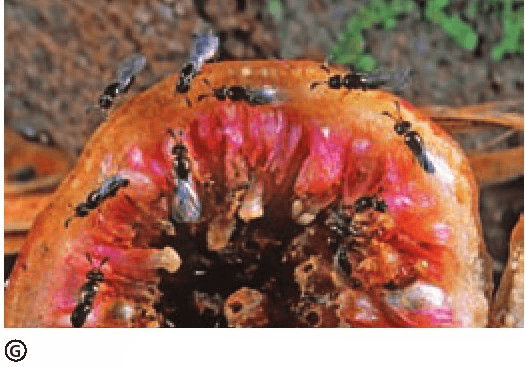
Generally, brightly colored and beautiful flowers can attract a variety of insects to visit and pollinate. The banyan tree is a hidden flower, which is not beautiful at all. How does it attract fig wasps to serve it? Analyzing the volatiles from the hidden heads of fig trees and the behavioral response of fig wasps to the volatiles, scientists found that fig trees achieved exclusive attraction to pollinating fig wasps by releasing a single uncommon volatile compound, thus establishing a specific symbiotic relationship between fig bees and fig wasps.
Studies found that during the flowering period of dioecious fig crop, 4-methylanisole accounted for the dominant position (94%-98%) of the cryptocephalic inflorescence volatiles, and completely disappeared 4 days after pollination or parasitization of the cryptocephalic inflorescence, and did not exist in the inflorescence volatiles of other species of fig trees. Biotesting further found that 4-methylanisole attracted to fig wasps in the chicken crop, while the inflorescence volatiles of other species of banyan trees that did not contain 4-methylanisole did not. It was this unusual banyan volatile compound that determined the specific attraction to fig pollinators in the chicken crop and established a unique symbiotic relationship between fig and fig wasps.
This result is just a "private conversation" between a banyan tree and a fig wasp. Do similar phenomena exist among other species? The answer is yes, which requires more exploration and discovery by successors.