
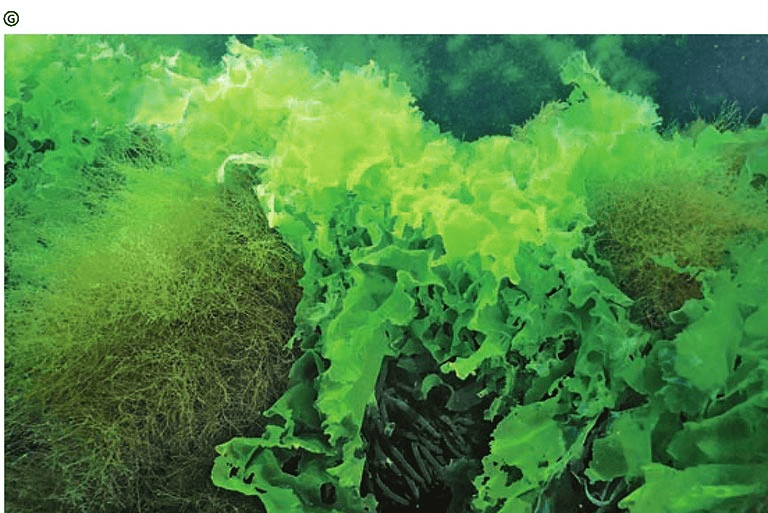
On the seaside in summer, we can see many green flaky algae on the reefs that emerge from the water after low tide. Its name is Ulva, commonly known as sea cabbage. It seems that these Ulva lulva all look similar, but in botany, they are two completely different plant bodies: one is a diploid individual and the other is a haploid individual. Why is this happening?
It turns out that, like other organisms, Ulva lactuca's life begins with a fertilized egg. Haploid sperm and haploid eggs fuse together to form a diploid zygote (fertilized egg), and from this zygote develops to form diploid Ulva lactuca. This is the same as in animals, and we call this diploid sporophyte. After the sporophyte has grown, it has to reproduce, and meiosis is then carried out. Generally, eggs or sperm are produced directly during meiosis in animals, but the haploid cells produced by Ulva lactata cannot be directly fertilized and require a process of continued growth and development. We call the cells produced by the meiosis of Ulva lactucci spores, and the haploid individuals developed by the spores are called the gametophyte, which is the haploid Ulva lactucci. The shape and size of the gametophyte are almost exactly the same as those of the diploid sporophyte. As the gametophyte grows, it produces germ cells such as sperm or egg cells. In this way, throughout the life cycle of Ulva lactuca, the phenomenon of alternating haploid individuals and diploid individuals appeared. The period from the beginning of zygote to the occurrence of meiosis is the asexual generation (sporophyte generation); from the beginning of spores to the formation of gametes, this period is the sexual generation (gametophyte generation). The alternation of sexual and asexual generations is called generational alternation.
In fact, not only Ulva, most plants have generations alternate. In algae, if sporophyte and gametophyte plants are the same in morphology and structure, it is called a homogeneous generation alternation, such as Ulva lactuca. Homomorphic generation alternation is relatively low-level in the history of plant evolution, and it evolves from it to heterogenous generation alternation. Heterogeneous generation alternation is the alternation of two plant bodies with different external shapes and internal structures. In the life cycle of alternate heterogenics, there is one type in which sporophytes are dominant, such as kelp; and the other type in which gametocytes are dominant, such as reef membrane and Xuanzao. It is generally believed that the types in which sporophytes dominate have evolved relatively.
After the plants landed, they developed in the direction of becoming more and more developed sporophytes and becoming more and more simplified gametophytes. For example, the sporophyte of ferns has obvious differentiation of roots, stems, and leaves. Although the gametophyte can also live independently, it is only a tiny flake and can only live in humid places. The sporophyte of angiosperms not only has roots, stems, and leaves, but also flowers, fruits, seeds and other organs. At the same time, the gametophyte is further simplified, consisting of only a few cells, and is parasitic on the sporophyte and cannot live independently.