How tall can trees grow?
This article focuses on the topic of "how tall can trees grow?" and introduces the height, distribution, and protection of various tall trees in China and around the world. It explains the principle that trees cannot grow infinitely tall due to water transport limitations, and mentions that scientists believe the maximum height for tree growth is between 120 and 130 meters.
Why are the annual rings some darker and some lighter?
This article focuses on the question of why annual rings are darker or lighter in color. It introduces the definition of annual rings, explains that the activity of the cambium layer in the stems of gymnosperms and dicotyledonous plants is affected by the seasons. The xylem formed in spring and summer is loose and light in color, while the xylem formed in autumn and winter is dense and dark in color, resulting in annual rings with alternating dark and light colors. It also demonstrates the role of annual rings in recording climate and environmental changes and estimating the age of old trees.
Why are there so many small holes in lotus root?
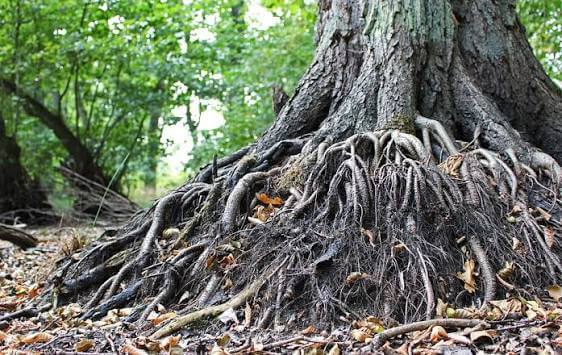
This article provides an answer to the question of "why there are so many small holes in lotus roots", explaining that the small holes inside lotus roots are specialized air vents that adapt to the anoxic environment of underwater silt. Their function is to transport the air obtained by the leaves to various parts of the stem. At the same time, the article introduces mangroves, which also grow in anoxic silt environments, and their different adaptive methods of obtaining oxygen by growing breathing roots that protrude above the ground.
Why do people still feel a lingering attachment even after a breakup?
This article addresses the question of "why broken lotus roots still cling to each other", and explains that the reason for this phenomenon is that after the lotus root is broken, the spiral part of its spiral conduit wall thickens and detaches to form a flexible filament. At the same time, it compares and explains that the filamentous substance that appears after Eucommia ulmoides is broken is due to the principle that the cellular fluid containing Eucommia gum secreted by its milk ducts forms rubber filaments.
Do all these strangely shaped stems have special functions?
This article focuses on answering the question "Do all oddly shaped stems have special functions?" It introduces the definition and characteristics of modified stems, and takes the tubers of potatoes, the bulbs of onions, and the rhizomes of lilies as examples to show that many plants with oddly shaped modified stems are the result of natural selection in different environments. Although they have lost the function of transporting water and nutrients, they possess special functions such as storing nutrients and protecting young shoots, aiming to better adapt to the environment and facilitate survival.
Why are most tree trunks cylindrical?
This article focuses on the question of why most tree trunks are cylindrical, and explains the rationality of cylindrical tree trunks from three aspects: transportation efficiency, supporting function, and safety protection. It points out that this morphological feature is a reflection of organisms' adaptation to the natural environment.
What are the four wonders of the tropical rainforest?
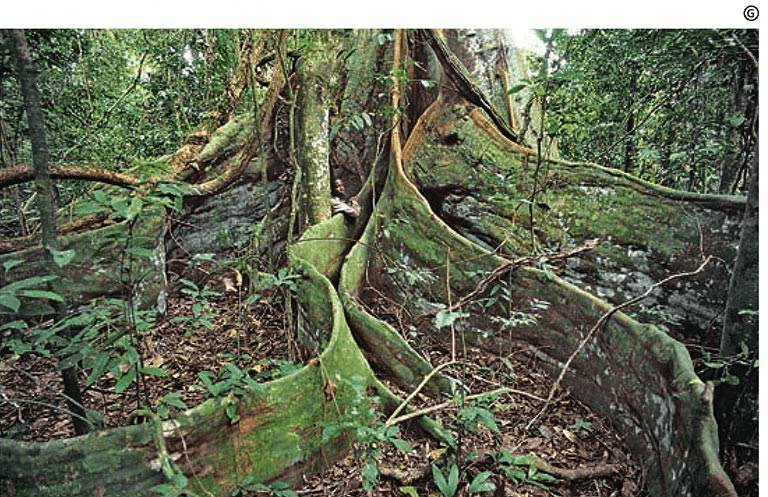
This article focuses on the question "What are the four wonders of the tropical rainforest?" It introduces the basic overview of the tropical rainforest, including its definition, distribution, and climate, and points out the four wonders of the tropical rainforest: the slab-like root phenomenon, the old stem flowering phenomenon, the aerial garden phenomenon, and the numerous liana plants. It also explains the characteristics and formation reasons of the aerial garden and liana plant wonders
Why are "fruits" grown on the trunks of large trees?
This article conducts a popular science explanation on the question of "why do fruits grow on the trunks of large trees?" It points out that these fruits, which seem to grow on the trunks, are actually developed from inflorescences, and belong to the phenomenon of old stems flowering in tropical rainforests. It lists common trees such as jackfruit, cocoa, and star fruit, and explains that this phenomenon is common in tropical rainforests to facilitate the spread of pollen and seeds.
Why do some big trees have plate-shaped roots at the base?
This article focuses on the question of why plate roots grow at the base of some big trees. It is introduced that plate roots are a unique landscape of tropical rainforests. Because trees with plate roots are usually tall and have similar thicknesses from top to bottom, underground root systems alone are not enough to support tall bodies, plate roots play the role of supporting the trunk like brackets around telephone poles, and are a kind of pillar roots.
Why can a single tree make a forest?
The article "Why can a single tree grow into a forest" introduces the miracle of a 900-year-old banyan tree forming a single tree forest that covers an area of more than 20,000 square meters and has nearly a thousand thick trunks supporting a huge crown. It also explains that the banyan tree relies on air roots. The principle of growth and development to form a single tree forest landscape.
How to identify the root's "identity"?
This paper explains the method of identifying the "identity" of roots by introducing the respective characteristics and typical examples of root systems of three types of plants: straight root system, fibrous root system, and adventitious root system.
What is the role of roots?
This article focuses on "what is the role of roots", explaining that roots are an important part of plants. They can not only absorb water and mineral nutrients in the soil through a large number of root hairs for plant growth, but also support and fix the plant and ensure the stability of the plant. role.